






The updated CATS: CBT for Anxiety Treatment in Schools (K-8) Implementer Manual and Student Workbook are now available at www.WorkbookPublishing.com. This post is about what is in them and how they got there.
The constraint came first
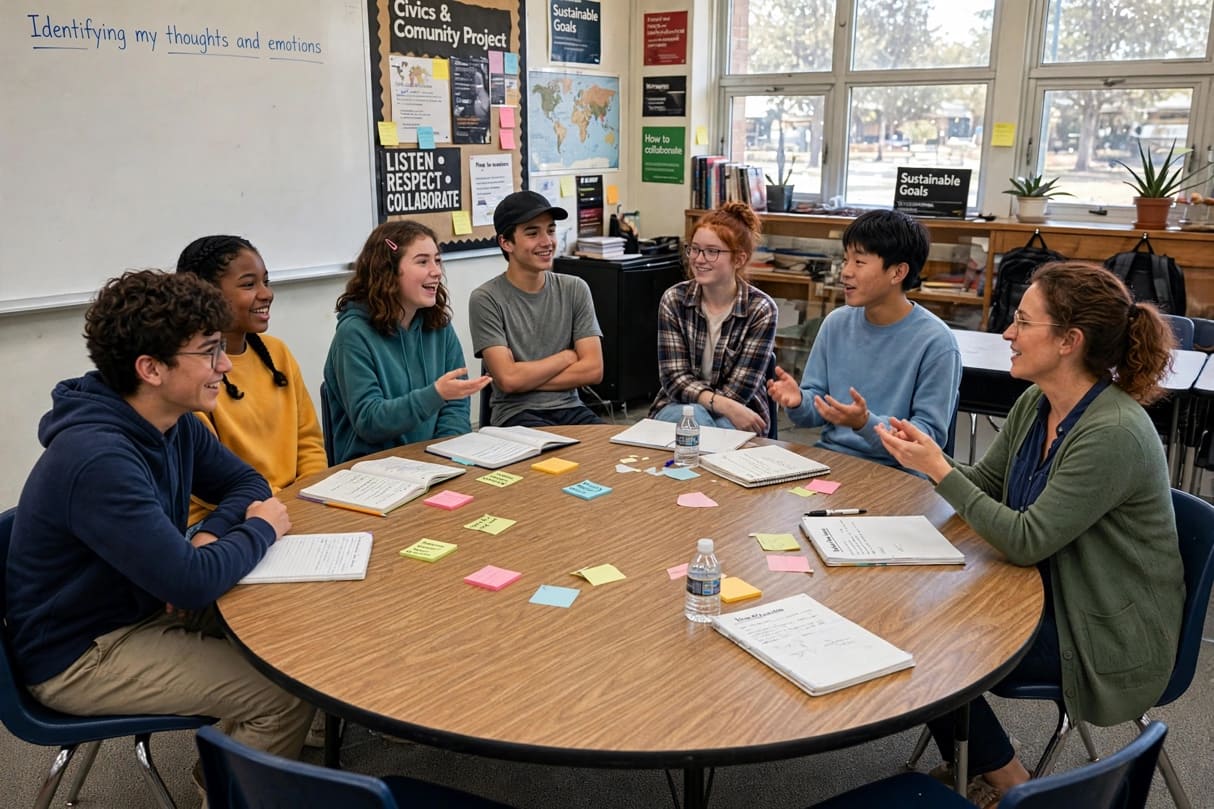
8, 35-minute class periods. 6-8 students.
Most treatment development runs in one direction. Establish efficacy in a controlled setting, then ask how to move it into the real world. The trouble is that by the time you get to implementation, the thing you are trying to implement has already been shaped by conditions that do not exist in the setting you are trying to reach.
CATS draws on the Coping Cat protocol developed by co-author Dr. Philip Kendall, and it retains all five core components of evidence-based CBT for youth anxiety:
Psychoeducation. Helping students recognize what anxiety is and how it shows up in the body.
Somatic management. Concrete skills for the physical experience of anxiety.
Cognitive restructuring. Identifying and examining anxious thoughts in the situations that provoke them.
Exposure. The active ingredient, and the one most often quietly dropped in school settings.
Relapse prevention. Building a coping plan students can carry forward, plus self-evaluation and self-reinforcement.
What we compressed was everything else: redundancy, pacing built for a longer arc, activities that assumed materials or time schools do not have.
What we rewrote was for fit. Language, examples, scenarios, and activities were revised for cultural and contextual fit with students in United States public schools, including under-resourced urban schools and remote rural schools. We surveyed providers and trainers about the appropriateness of content for the target population, and we revised based on what they told us. That work was done up front, in the manual, so it does not have to be done in the hallway five minutes before group.
What the trials actually showed
The evidence base behind CATS occurred over 15 years, spanning 140 schools, from large urban districts to remote rural communities, roughly 300 implementers, and about 1,600 students in grades 4 through 8.
Shorter still produced results. Across trials, eight sessions produced reductions in student anxiety and improvements in engagement with learning.
Clinicians found it fit. In qualitative interviews, implementers and supervisors delivering CATS described the curriculum as accessible and appropriate for the students in their groups. The extensive rewriting that school clinicians so often end up doing on their own did not come up in the same way.
Schools can afford it. Formal cost-effectiveness analysis found CATS to be good value across every willingness-to-pay threshold we examined. Fewer sessions translates directly into lower cost per group cohort, which matters when a district is deciding what survives the next budget cycle.
It holds up when the support fades. Implementers in the reduced-support condition continued delivering the program with warmth, clarity, and organization. Sustainability is where most school-based programs die. This one did not.
The honest limits
I would rather you hear this from me than discover it in the discussion section.
The within-group symptom reductions in our effectiveness trials were small. That is consistent with what happens when interventions move from controlled settings into real ones, and consistent with what prevention research generally finds in lower-acuity samples. It is not a reason to skip the work, since programs delivered at scale can produce meaningful population-level change even with modest individual effects. But it is a reason to be honest about what one eight-session group will and will not do for a severely anxious child.
Dosage was a real problem. Attendance varied. Group cohorts completed varied considerably across schools. If your students do not show up, none of this works, and the manual cannot solve that for you.
Our trials enrolled students in grades 4 through 8. The manual covers K-8, and the younger end rests more on clinical judgment and the underlying Coping Cat evidence base than on our own data.
And implementers told us clearly what they still wanted: more supervision. Those who went without coach support wished they had it. Those who had it reduced wanted it more often. The protocol is not a substitute for someone to think out loud with.
What to do with this
If you are a school psychologist, social worker, or agency clinician with a list of anxious students you cannot get to, here is the practical version.
You need a protected 35-minute block, eight times. You need six to eight students, identified through whatever anxiety screening your school already uses (we used the SCARED). You need a room. You need the implementer manual and a student workbook for each participant.
That is the whole apparatus. It was designed to be that small on purpose.
There are close to 100,000 schools in this country. If each one ran a single group of six to eight students in a year, that would reach more than 600,000 children. Most of them would otherwise not have access to evidence-based care.
--
Acknowledgements
This work exists because of Dr. Ricardo Eiraldi, our long-time collaborator and friend, who kept pushing all of us past "does it work" toward the harder question of whether a real school could do this and keep doing it.
To Philip Kendall, whose Coping Cat work is the foundation everything CATS is built on.
To Abbas Jawad, Courtney Benjamin Wolk, Rinad Beidas, Jennifer Mautone, Gwendolyn Lawson, Rachel Comly, Barry McCurdy, Henry Glick, Billie Schwartz, Tara Wilson, Quinn Rabenau-McDonnell, Kathryn Henson, and the teams at Children's Hospital of Philadelphia (CHOP) and the School District of Philadelphia.
And most of all to the counselors, social workers, clinicians, coaches, principals, teachers, district administrators, students, and families who let us into their buildings, told us plainly what was not working, and showed us what it actually takes to make evidence-based care function in the real world. Every revision in CATS traces back to something one of them said.
The CATS Implementer Manual and Student Workbook are available now at www.WorkbookPublishing.com.
For training for your district, school, or team, email Dr. Khanna at muniya@muniyakhannaphd.com
This work was supported by the National Institute of Mental Health. Disclosure: Drs. Khanna and Kendall receive royalties from Workbook Publishing as authors of the CATS manual and student workbook.
Learn More:
(2026) Implementation and student outcomes of an implementation strategy for the sustainability of group evidence-based practices in schools
